
From DNS Hijacking to Stealing Over $600K
A blockchain security investigation into the 2022 Curve Finance DNS hijacking attack, tracing the malicious approval flow and calculating the stolen funds.
ON THIS PAGE / 7 SECTIONS
From DNS Hijacking to Stealing Over $600K
Note
This write-up is based on a task from Forta’s Blockchain Security course. I highly recommend the course if you’re interested in blockchain security.
Incident Overview
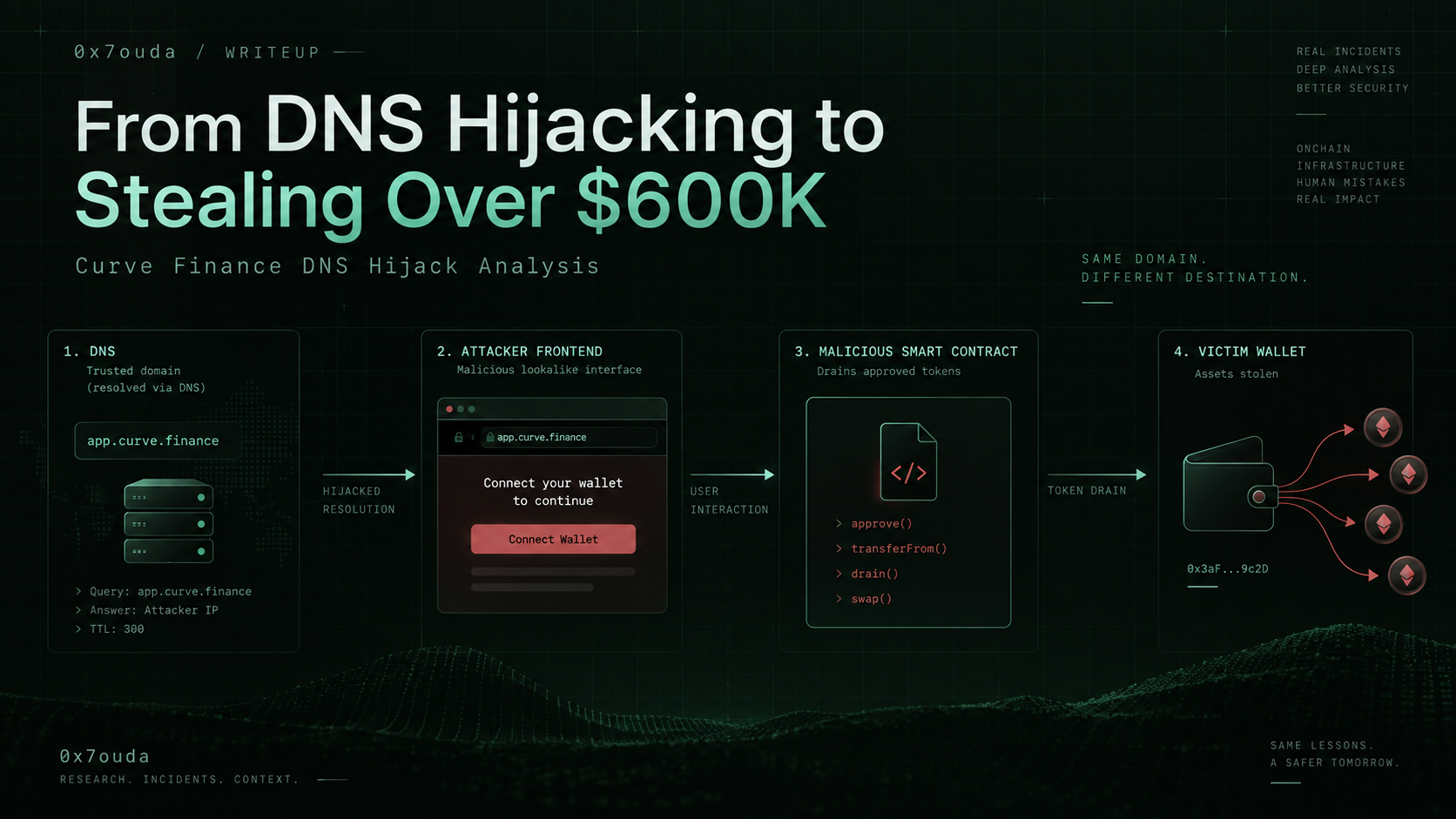
On August 9, 2022, Curve Finance suffered a DNS hijacking attack affecting its official domain, curve.fi. The attacker compromised the DNS configuration associated with Curve’s domain registrar, iwantmyname, and modified the DNS records to point the legitimate domain to an attacker-controlled server.
As a result, users who visited curve.fi were served a malicious clone of the Curve Finance frontend. Although the website appeared legitimate, malicious code had been injected into the page to trick users into approving an attacker-controlled smart contract. Once a victim approved the contract, the attacker could use that approval to transfer the victim’s tokens without requiring another confirmation.
We begin our investigation with the known attacker address:
0x50f9202e0f1c1577822BD67193960B213CD2f331After searching for the attacker’s address on Etherscan, we opened the ERC-20 Token Transfers tab to review its token activity. By checking the older transfers, we identified the following transactions:

The first transactions appear to be a test of the attack flow. The attacker sent 16.880678 USDC to 0x4547..., and the same amount was later transferred back through the suspicious contract. This suggests that the attacker was testing whether the malicious transfer mechanism was working correctly.
We will set these transactions aside for now and continue analyzing the subsequent activity.
Malicious Approval Flow
Note: The malicious website tricked users into approving the attacker’s contract while they believed they were performing a normal approval to use Curve. After this approval was granted, the attacker could use the malicious contract to transfer the victim’s tokens without asking for another approval.
When we open transaction 0x32faf49f..., we can see that the attacker did not receive the funds through a direct transfer from the victim. Instead, the attacker interacted with the malicious contract 0x9Eb5...8881, as shown in the transaction details and input data. This indicates that the contract was used to pull the victim’s tokens and transfer them to the attacker.


Input Data
0x9c307de6000000000000000000000000a0b86991c6218b36c1d19d4a2e9eb0ce3606eb48000000000000000000000000986680f665eb6fb6f72c9df209468e3426517bc6If you have some knowledge of the EVM and ABI encoding, you can see that the calldata is divided into three parts: a 4-byte function selector followed by two 32-byte ABI-encoded parameters.
// Reconstructed from the deployed bytecode
function function_9c307de6(
    address token,
    address target
) external {
    _drain(token, target);
}

function _drain(
    address token,
    address target
) internal {

    uint256 balance =
        IERC20(token).balanceOf(target);

    uint256 approved =
        IERC20(token).allowance(
            target,
            address(this)
        );

    if (balance > 0 && approved > 0) {

        uint256 amount =
            balance < approved
                ? balance
                : approved;

        IERC20(token).transferFrom(
            target,
            recipient,
            amount
        );
    }
}
The function takes two parameters:
address token = 0xa0b86991c6218b36c1d19d4a2e9eb0ce3606eb48
address target = 986680f665eb6fb6f72c9df209468e3426517bc6
The first parameter identifies which ERC-20 token the contract should interact with, while the second parameter identifies the wallet address from which the tokens will be transferred — the victim wallet.
The function checks the target wallet’s token balance and the allowance granted to the malicious contract. If both values are greater than zero, it transfers the smaller of the balance and the allowance. Since the victims granted an unlimited approval, the contract could effectively transfer the victim’s entire available token balance.
By checking the target wallet, we can confirm that the token-draining operation was successful and the USDC was transferred to the attacker address.

Calculating the Total Amount Stolen
Our second objective is to calculate the total amount stolen. After testing several approaches, the most effective method was to use Dune Analytics, a web-based platform that allows us to query blockchain data using SQL and aggregate the relevant transactions.
WITH stolen AS (

    SELECT
        t.block_time,
        t.tx_hash,
        t."from" AS victim,
        t."to" AS attacker,
        t.symbol,
        t.contract_address,
        t.amount,
        t.amount_usd

    FROM tokens.transfers t

    INNER JOIN ethereum.transactions tx
        ON t.tx_hash = tx.hash

    WHERE t.blockchain = 'ethereum'

      AND t.block_date = DATE '2022-08-09'

      AND t."to" =
          0x50f9202e0f1c1577822BD67193960B213CD2f331

      AND tx."from" =
          0x50f9202e0f1c1577822BD67193960B213CD2f331

      AND tx."to" =
          0x9Eb5F8e83359Bb5013f3D8eee60bDCe5654e8881

      AND t.contract_address IN (
          0xA0b86991c6218b36c1d19d4a2e9eb0ce3606eb48, -- USDC
          0x6B175474E89094C44Da98b954EedeAC495271d0F  -- DAI
      )
)

SELECT
    COUNT(DISTINCT tx_hash) AS number_of_transactions,
    COUNT(DISTINCT victim) AS number_of_victims,
    SUM(amount_usd) AS total_stolen_usd
FROM stolen;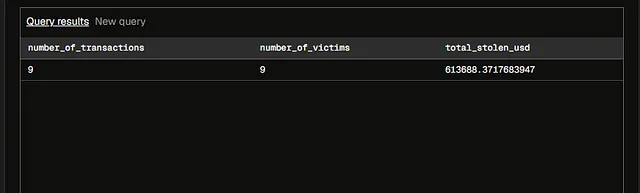
Thanks for Reading
I recommend this course if you’re interested in blockchain security.
Keep the investigation open.
Have another interpretation, a correction, or a useful trace? Reach out on Discord.
Continue on Discord